You launch a new offer. Maybe it's a cheaper first bottle, or a free gift with the first order.
It works. More people buy, and each one costs less to win.
Six months later, those customers are reordering much less than the ones before them.
The product is the same. The price is the same. The offer brought in a different kind of customer.
And that's the dangerous part, because you won't see it coming.
A supplement brand we worked with ran into exactly this.
People loved their product. About half of their new customers used to sign up for a subscription on their first order.
Then they tested new offers to win more customers. After that, only about a quarter signed up.
Their retention numbers didn't show it. Those numbers came from older customers, the ones who had signed up at the old rate.
That's the trouble with retention. It's slow. It shows you what happened to customers you won months ago.
So in this post, you'll get two things. First, what retention looks like for supplement subscriptions in 2026. Then, the number that would have warned this brand much sooner.
Supplement subscription retention rate: the short answer
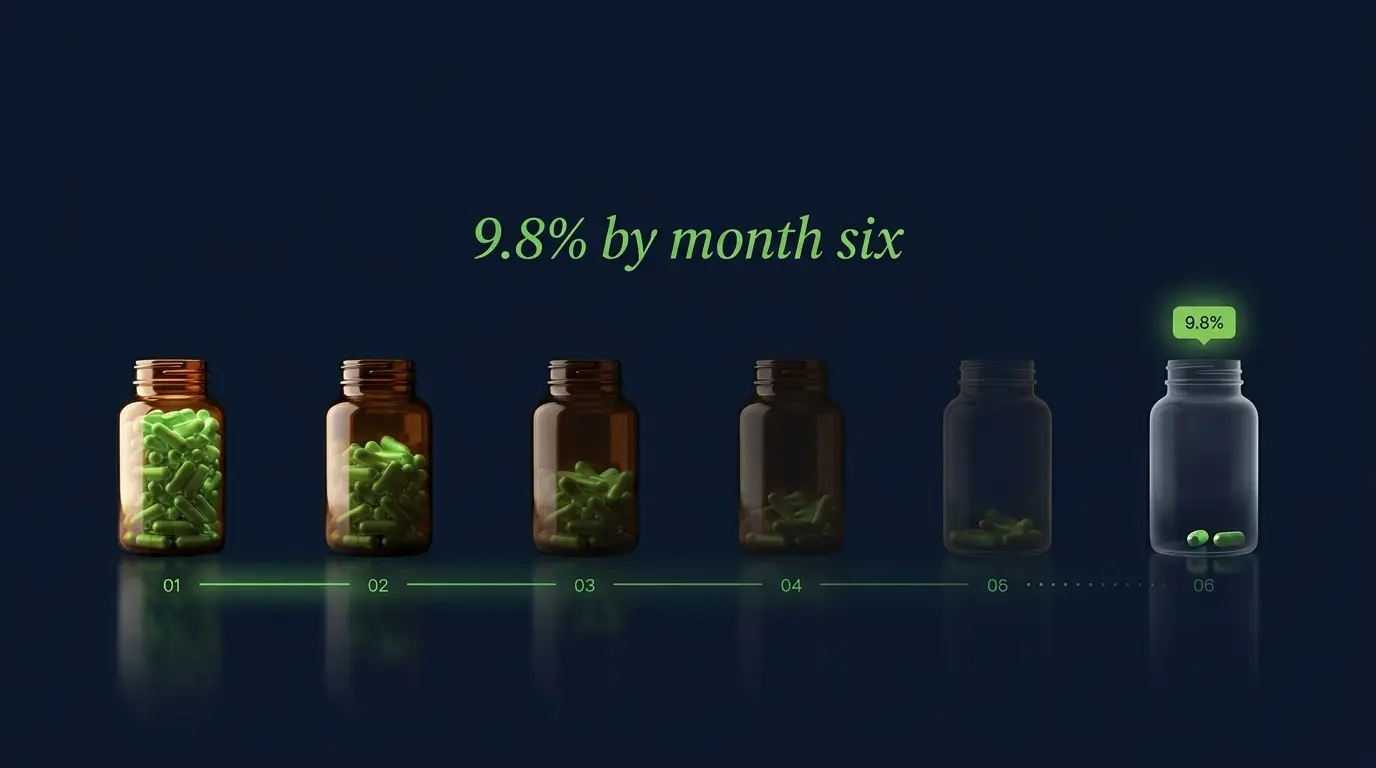
About 9.8% of supplement subscribers are still ordering six months after they sign up.
That's from Recharge, the subscription platform, which tracked cohorts across about 1,800 supplement brands from mid-2025 to mid-2026.
Most of the drop happens early. Only 86.6% of new subscribers make it to their first reorder. By month three, about a third are left.
One note on how that's counted: "month six" means the sixth reorder on a monthly plan. Recharge counts orders, not calendar months.
It's a useful number for knowing where you stand. But every customer behind it signed up months ago. It can't tell you anything about the customers you signed up this month.
Below are the full numbers. After that, the number that moves first.
Average retention rate for supplement subscriptions
Here's the full picture from Recharge's data. All the figures in this section are theirs.
How many subscribers are left at each reorder
The steepest drop comes between the first and third reorders. By month three, two out of every three subscribers have gone.
After that, the numbers get smaller, but the losses don't stop. Of the subscribers still there at month six, only about four in ten make it to month nine.
How supplements compare with other subscriptions
Supplements have the weakest first reorder of the five categories. More new subscribers leave before their second shipment than anywhere else.
By month six, though, supplements have caught up. They're level with health and wellness, ahead of beauty and coffee, and behind pet supplies.
So the supplement problem sits mostly in the first month or two.
That's good news, because it's the part you have the most control over: how new subscribers are welcomed, when the first shipment arrives, and what they're offered before their second order.
What happens at each renewal
Every time a subscription comes up for renewal, one of three things happens. The order goes through, the subscriber skips it, or they cancel.
Across the individual supplement stores Recharge looked at, the middle store had a cancel rate of 16.4% per renewal.
Supplements have the highest skip rate of the five categories. A skip isn't a lost customer, but it is a delayed order.
Recharge doesn't say why people skip. A likely reason is that bottles pile up faster than people use them. Either way, it's worth tracking skips separately from cancellations, because they need different fixes.
One word of caution. That 17.3% is a rate per renewal, not a monthly churn rate. Recharge doesn't give a precise definition, so be careful comparing it with churn figures from other sources.
Numbers you'll see elsewhere
If you search for supplement retention benchmarks, you'll come across other figures. A 29% repeat purchase rate for supplement stores. Monthly churn of 8.8% for health and wellness. Retention of 45% at month six.
We couldn't trace any of them to an original source. The 45% figure also doesn't match Recharge's own data, which puts month-six retention closer to 10%.
So we've left them out of this post.
Subscribe and save vs. one-time supplement customers
To see why the share of subscribers matters so much, it helps to put a number on each type of customer.
Here's a simple example. The figures are illustrative, but they're the same ones we use across our supplement posts.
Illustrative figures. Lifetime gross profit is gross profit per order times the number of orders, rounded.
One subscriber is worth more than three one-time buyers.
A quick note on the 4.5 orders. That's a stronger subscription program than the Recharge average above, and it's deliberate. It's closer to the brand in this story, whose retention was well above typical.
If your subscribers look more like the Recharge average, the gap between the two types of customer will be smaller, but it will still be large.
Either way, most of what a new customer is worth comes down to one thing: whether they subscribe.
That means the share of new customers who subscribe drives most of your lifetime value. It also sets how much you can afford to pay to win each one.
If you sell on Amazon too, keep Subscribe & Save subscribers separate.
Each shipment earns you less after Amazon's fees, and you see far less about who those customers are. Amazon vs Shopify for supplement brands works through the numbers.
Why retention numbers always arrive late
Most supplement brands work out lifetime value the same way. They pull a cohort report from Shopify, look at how past customers behaved, and assume new customers will do the same.
That's a sensible place to start. It has three problems, and they all come from timing.
Past customers don't predict new ones
Say the customers you won seven months ago had 12% retention at month six.
That doesn't mean the customers you won last month will too. Since then, you may have changed your offer, your ads or your product range. New competitors may have launched.
The customers you're winning now are coming in under different conditions.
The further ahead you look, the older your data
To know what a customer is worth over 12 months, you need customers who have been around for at least 13 months.
So your 12-month lifetime value describes people who joined your brand more than a year ago. The business they joined isn't quite the one you're running today.
Improvements are hard to read too
The brand in this story had a good reason to feel confident.
They'd made real improvements to their subscription program. Customers from recent months were sticking around better at month three than older customers had.
So they assumed month six would improve too. It was a reasonable guess. But they didn't have any month-six data for those customers yet, so it was still a guess.
And while they were waiting to find out, something else was changing underneath. Fewer new customers were subscribing in the first place.
What that adds up to
Retention numbers tell you what happened to customers you won months ago. By the time they change, you can't do anything about those customers.
What you need is a number about the customers you're winning right now.
Subscription mix: the number that moves first
That number is your subscription mix.
It's simple. Of the new customers you won this month, what share started a subscription on their first order?
Track it by the month customers were acquired, so every month's group of new customers gets its own figure.
Why it warns you first
Subscription mix is fixed the moment someone places their first order. You don't have to wait for anyone to reorder.
And because a subscriber is worth so much more than a one-time buyer, a change in your mix is a change in what your new customers are worth.
You can see it the same month it happens.
What a slipping mix costs
Here's what a slow slide looks like, using the same illustrative figures from earlier. A one-time buyer is worth $59, and a subscriber is worth $189.
Illustrative figures. Each value is the subscriber share × $189, plus the one-time share × $59.
Every 5 points of mix you lose takes $6.50 off what each new customer is worth.
Over six months, that's $32.50 per customer. A quarter of their value, gone.
Why the timing matters
Now think about when you'd find out.
If you're watching retention, you'll see month-six retention for Month 1's customers around the end of this table. Not before.
By then, you've won five more months of customers. Each month's group was worth less than the one before, and you were paying for all of them as if they were worth $124.
Your subscription mix would have shown you the problem in Month 2.
Where the brand in this story ended up
The brand in this story went from about half its new customers subscribing to about a quarter.
In this example, a 25% mix puts each new customer's value at $91.50. When we corrected the brand's real numbers, the most it could afford to pay per customer came out at about $90. It was paying about $120.
What's a good CAC for supplement companies explains how those two numbers line up, and what else pushed the brand's costs past its limit.
How a winning offer can shrink your lifetime value
For the brand in this story, the drop in subscribers came from testing new offers.
That's the uncomfortable part. An offer can win on every number you usually check and still bring in fewer subscribers.
A cheaper first bottle, for example, is great at getting people to try you. It's often much less good at getting them to commit to a subscription.
So the offer that wins your test can be the one that lowers what each new customer is worth.
We walked through an example of this in what's a good CAC for supplement companies. One offer won customers 37% more cheaply than the other.
The second offer made 2.2 times as much money per customer, because far more of its customers subscribed.
On a normal dashboard, the first offer looks like the clear winner.
When losing money on the first order makes sense
This matters even more for supplement brands, because the best ones are often willing to lose money on a customer's first order.
That can be a smart strategy. If your customers keep reordering, you can afford to pay more than your competitors to win them, and you'll win more of them.
The money comes back over the following months.
But that only works if the customers really do come back. Your subscription mix is how you know whether they will.
When the mix drops, the case for losing money on the first order drops with it.
So think back to the last offer test that won on cost per customer. Did anyone check what it did to the share of new customers who subscribed?
How to track subscription mix
You don't need new software for this. You need a simple monthly habit.
Track it by month, not all-time
Look at each month's new customers on their own. What share of them subscribed on their first order?
Don't use one all-time ratio across your whole customer base. Older subscribers will prop it up, and it'll look healthy long after your new customers have stopped subscribing.
It's the same way old customers can make flat revenue look stable while new sales are falling. Why supplement brands plateau covers how that happens.
Split it by offer
Give every first-order offer its own subscription mix.
This is where a bad test shows up first. If one offer brings in 70% subscribers and another brings in 20%, you'll want to know before you move your budget to the cheaper one.
Split it by channel, where you can
Shopify gives you this directly.
Amazon's Subscribe & Save reporting is much more limited, so keep it separate rather than blending it in. Mixing the two will make both numbers harder to read.
Check it against your forecast every month
Anyone can build a lifetime value forecast. The useful part is checking it each month: where was it wrong, and why?
Subscription mix is the first thing to check. If your forecast assumed 50% of new customers would subscribe and this month's customers came in at 40%, the forecast is already wrong for them.
Then ask whether it's a one-off, or a sign that the assumption itself needs to change.
Update what you can afford to pay
When the mix moves by more than a few points, don't wait for retention to confirm it.
Lower the amount you're willing to pay for those customers straight away, using the mix they actually came in at. Retention will tell you the same thing eventually. By then you'll have spent months paying too much.
What to do when your subscription mix drops
If this month's new customers are subscribing less than usual, work through these in order.
1. Find the cause. It's usually something that changed that month. A new offer, a new channel, or a change to the subscription offer itself. Check what launched.
2. Judge the offer on what each customer is worth, not on what they cost to win. A cheaper customer who never subscribes can be the more expensive one in the end.
3. Lower what you'll pay for that month's customers now, while the offer is still running. Don't wait for the retention numbers to catch up.
4. Make subscribing the easy choice. Look at the first order from the customer's side. Is subscribing clearly the better deal, and is it simple to choose?
Fixing the front-end offer won't help much if the subscription offer behind it is weak.
5. Watch the first reorder closely. Supplements lose more subscribers before the second shipment than any other category Recharge tracks.
A subscriber who cancels before their second order is worth little more than a one-time buyer.
Putting it together
Retention tells you where you stood. Subscription mix tells you where you're heading.
The gap between the two is about six months. That's six months of new customers you'd be paying for on the wrong assumption.
The brand in this story had genuinely excellent retention. What they missed was that the customers they were adding had stopped subscribing at the old rate.
If you'd rather see this on your own numbers
Tracking subscription mix by month and by offer is something you can set up yourself, and if it comes back steady, that's a good answer.
If you'd rather see the full picture, that's what the Growth Cash Dash is for.
We take your historical numbers, run them through 30+ ecommerce finance KPIs, and come back with the ones that are telling a story your dashboard isn't.
Subscription mix is one of them. We'll show you what your current mix means for the lifetime value you're planning around, and for how much you can really afford to pay for each new customer.
Sometimes it confirms your forecast is sound. Sometimes it finds a $90 limit sitting underneath a $120 cost per customer.
Either way, you'll know which one you're dealing with.





.jpg)