The giants of ecommerce are fighting tooth and nail for your dollars, and the stakes couldn't be higher.
We're talking about companies worth billions duking it out across the digital landscape.
So who's actually winning this fight? Which companies have claimed the biggest piece of the ecommerce pie?
That's exactly what we're diving into today.
Who has the largest market share in eCommerce?
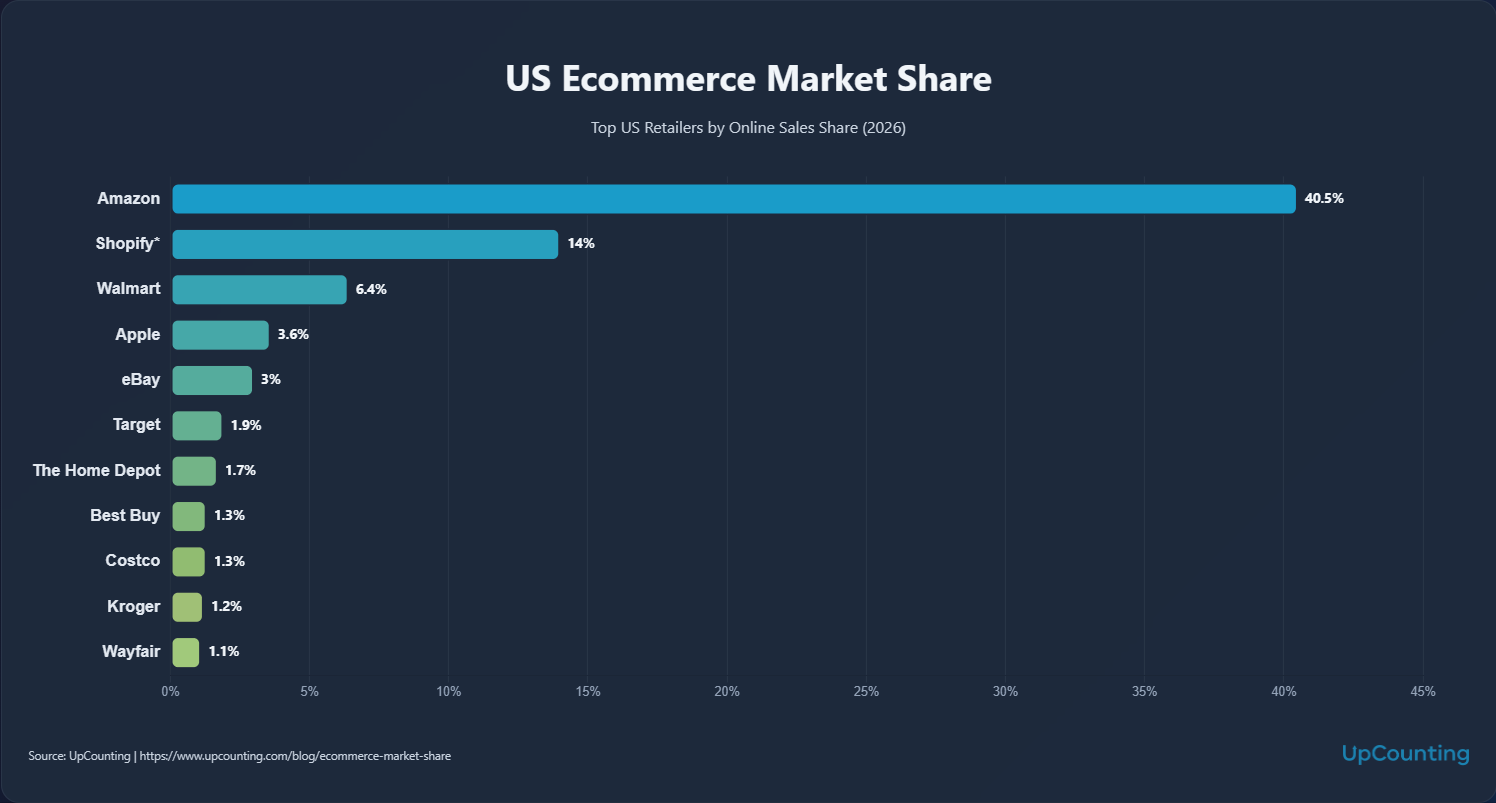
As of 2026, Amazon accounts for roughly 40.5% of the US retail ecommerce market - somewhere in the neighborhood of $490 billion in sales - making it the single biggest player by a wide margin, according to Statista.
Here's the twist worth noting: Amazon's slice of the pie has stopped expanding. It peaked at around 41.8% back in 2021, and competitors have been chipping away at the edges ever since. Amazon is still the 800-pound gorilla, but it's no longer growing its dominance unchecked.
In fact, when you add Shopify into the mix - the platform quietly powering millions of independent stores - the two together now control more than half of all US ecommerce. That's a remarkable concentration of online retail in just two players' hands.
*Shopify isn't a single retailer but a platform powering millions of independent stores; its ~14% reflects the combined ecommerce flowing through those merchants. Sources: Statista, Marketplace Pulse.
Founded by Jeff Bezos in 1994 as an online bookstore, this company has morphed into what many call "The Everything Store."
What's their secret sauce? It's not just one thing.
It's their Prime membership program creating loyalty, their massive product selection, their logistics network that gets stuff to you insanely fast, and their willingness to operate on razor-thin margins for years to crush competition.
But here's something to think about - is Amazon's dominance good for consumers in the long run?
Sure, the convenience is incredible now, but what happens when they've eliminated enough competition to start jacking up prices?
Alibaba Group: The Eastern Giant
If you think Amazon is big, you need to look at Alibaba.
This Chinese powerhouse isn't just one platform - it's a collection of marketplaces including Taobao, Tmall, and AliExpress that collectively dominate the Asian ecommerce landscape.
Singles' Day is the best illustration of their scale. What used to be a single 24-hour shopping blitz has now stretched into a multi-week campaign, and in 2025 the total gross merchandise value across the whole event topped 1.5 trillion RMB (well over $200 billion).
Alibaba has stopped disclosing its exact single-day numbers, but it still commands the lion's share of that total. Let that sink in for a second - that's many times more than Black Friday and Cyber Monday combined.
The interesting thing about Alibaba is their business model differs significantly from Amazon.
While Amazon sells directly to consumers, Alibaba primarily operates as a marketplace connecting buyers and sellers.
They're less about owning the entire supply chain and more about creating the infrastructure for commerce.
Walmart: The Old Guard's Digital Transformation
Don't count out traditional retailers just yet. Walmart has been aggressively expanding its digital presence, and its online sales hit roughly $150 billion in fiscal 2026 - up more than 20% year over year - cementing its position as the second-largest single online retailer in the US.
What's fascinating about Walmart is how they've leveraged their physical stores as distribution centers, allowing them to offer same-day pickup and delivery in ways that pure-play online retailers struggle to match.
Their acquisition of Jet.com and investments in other digital platforms show they're dead serious about not becoming retail dinosaurs.
Other Notable Contenders
The ecommerce space isn't just a two or three-horse race. eBay still maintains significant market share in the C2C space. And Shopify has become arguably the most important player you don't think of as a "store" - it now powers around 14% of all US ecommerce by quietly running the checkout for millions of independent brands.
Target has dramatically expanded its digital footprint. And specialized players like Etsy dominate specific niches.
Then there's the rapid rise of Chinese fast-fashion retailer Shein, which came seemingly out of nowhere to capture massive market share among younger shoppers looking for dirt-cheap trendy clothes - racking up an estimated $80+ billion in global sales.
And right alongside it is Temu, the discount marketplace owned by PDD Holdings (the same parent as Pinduoduo). Temu blitzed its way into the US market with aggressive ad spending and rock-bottom prices, becoming one of the most downloaded apps in the country almost overnight - though tighter rules on cheap import shipments have started to test that model.
Regional Market Leaders
The global picture gets even more interesting when you break it down by region, because consumer behaviors, infrastructure, and regulatory environments vary dramatically.
North America
While Amazon dominates in the US and Canada, the landscape includes strong regional players.
In Canada, companies like Shopify (headquartered there) and Canadian Tire have carved out significant positions.
In Mexico, MercadoLibre is a major force alongside Amazon.
What's worth noting is how different the US market is from others - Americans show less concern about data privacy than Europeans and greater willingness to consolidate their shopping with a single platform for convenience.
Asia-Pacific
This region is absolutely exploding, with China leading the charge.
Beyond Alibaba , companies like JD.com and Pinduoduo are massive players most Westerners have barely heard of.
In India, the battle is intense between Flipkart (owned by Walmart) and Amazon, with homegrown players like Reliance's JioMart gaining ground.
The Southeast Asian market has its own dominant platform in Shopee, which has outmaneuvered both Western and Chinese competitors in countries like Indonesia, Thailand, and Vietnam.
Japan remains somewhat unique, with Rakuten maintaining strong market position despite Amazon's presence, largely due to their deep integration into Japanese consumer culture and banking systems.
Europe
Europe's ecommerce landscape is fascinating because it's fragmented along both national and linguistic lines.
While Amazon has strong positions in the UK, Germany, and France, it doesn't dominate to the same degree as in the US.
Local champions like Otto in Germany, Zalando across Europe for fashion, and Asos in the UK maintain significant market share.
The Netherlands has Bol.com, while Poland has Allegro - both successfully fending off the American giants.
What's really interesting about Europe is how regulatory environments shape competition.
The EU's strict data privacy laws and antitrust enforcement create a more level playing field than in the US.
When European regulators slap Amazon or Google with billion-euro fines, it's not just symbolic - it actually changes business practices.
Latin America
If you're not paying attention to Latin American ecommerce, you're missing a major growth story. MercadoLibre (often called "the Amazon of Latin America") is the undisputed regional champion, especially strong in Brazil, Argentina, and Mexico.
What makes MercadoLibre particularly interesting is how they've built integrated payment systems (MercadoPago) that work for the region's large unbanked population. They didn't just copy Amazon's playbook - they adapted to local realities and solved specific regional problems.
Africa and Middle East
These regions represent the next frontier of ecommerce growth, with relatively low penetration today but massive potential given young, increasingly connected populations.
In the Middle East, Amazon-owned Souq.com and Noon.com battle for dominance, while in Africa, Jumia stands as the continent's leading platform despite significant logistical challenges.
What's fascinating about these emerging markets is watching how they leapfrog development stages.
Many consumers in these regions went straight from no internet to mobile shopping, skipping the desktop era entirely.
Future Trends and Potential Market Shifts
The line between scrolling through social media and shopping is getting blurrier by the day. Platforms like Instagram, TikTok, and Pinterest aren't just places to kill time anymore; they're becoming legitimate shopping destinations.
TikTok Shop is absolutely exploding right now. Its US sales are projected to hit around $23 billion in 2026 - a roughly 48% jump year over year - which would make it a bigger US ecommerce business than Target, Costco, Best Buy, or Kroger.
What started as a simple video-sharing app has morphed into a commerce powerhouse where creators can sell products directly through their videos. By 2026, more than half of all US social shoppers - well over 50 million people - are buying through TikTok.
The conversion rates are insane compared to traditional advertising because there's something powerful about seeing real people use products in authentic ways. TikTok Shop reportedly converts at more than double the rate of Instagram or Facebook shopping.
Meta (formerly Facebook) isn't sitting on the sidelines either.
Their Instagram Shop feature turns your feed into a personalized catalog, and they're betting big that social shopping will be the next evolution of ecommerce.
When your friend posts a photo wearing those shoes you love, you can now buy them with a couple of taps.
Regulatory Headwinds
The elephant in the room for market leaders is increasing regulatory scrutiny. Governments worldwide are waking up to the power these digital giants hold over commerce, and they're starting to act.
Antitrust investigations into Amazon are ongoing in both the US and Europe.
China has already cracked down on Alibaba with massive fines and forced restructuring.
The EU's Digital Markets Act specifically targets large "gatekeeper" platforms with restrictions on how they can leverage their power.
These regulatory actions aren't just academic - they could fundamentally reshape the competitive landscape.
Some of this is already happening. Court rulings have forced Apple to let developers point users to cheaper payment options outside the App Store, chipping away at its long-standing 30% cut, and regulators are pushing hard on whether Amazon can preference its own products in search results.
The entire power dynamic of ecommerce is genuinely starting to shift.
Is this all speculative? Sure. But remember that in 1995, Amazon was just a website selling books.
The ecommerce landscape has been continuously disrupted, and there's no reason to think we've reached its final form.






.jpg)