
Sales have been flat for a few months.
The ads still work, but each week they cost a little more to bring in the same number of customers.
The ads that carried the account last year are still running, because nothing new has beaten them.
So the conclusion feels obvious: we've tapped out Meta.
The next month there's a Google agency on retainer.
Then a TikTok creator program.
Then YouTube, a round of promotions, a few influencers, and a podcast sponsorship.
Each of those decisions makes sense on its own. Each one feels like progress.
Together, they tend to make the real problem much harder to see.
A supplement brand we worked with went through exactly this.
They were spending about $200,000 a month on Meta, and they'd been growing well for three years before everything stalled.
They were a sophisticated team with a product people liked, and their retention was impressively high. When revenue stopped climbing, they did what most smart operators would do.
They assumed they'd reached the limit of the channel and started looking for the next one.
By the time they called us, they had six channels running and no clear way to tell which of them was working.
That was the question they wanted answered: where should the money go?
What they didn't know yet was that another supplement brand, in a similar niche and under the same advertising rules, was spending about $200,000 on Meta every day.
Same platform. Same restrictions on what a supplement ad can say. Roughly 30 times the spend.
So had this brand really hit Meta's ceiling? And if you're in the same spot, how would you know?
That's what this post works through: why supplement brands run into a ceiling on Meta earlier than most, what every extra channel really costs, how to test whether you've actually maxed out, and when adding a channel is the right call.
Have you saturated Meta? The short answer
Probably not. Most supplement brands that think they've saturated Meta have run out of ads that can win inside the rules supplements have to follow.
That's a different problem from saturation, with a different fix. On a dashboard, though, the two look identical: rising costs, and the same tired ads carrying the account.
You can get a rough read on which one you're facing with three questions.
When a new ad wins, does your cost per customer come down?
If a fresh winner still pulls costs down, there's more room on the platform. What you're short on is winners.
How many genuinely new angles did you test last month?
A new hook on the same idea, or the same video recut, doesn't count. A new angle is a different reason for someone to buy.
If the honest answer is "one or two," all you've learned so far is how far your current idea can stretch.
Is anyone in your category spending far more on Meta than you?
If a brand selling something similar, under the same rules, is spending well beyond your level, the platform can hold more supplement spend than you're currently giving it.
For the brand in this story, the answer to that last question was about 30 times more.
If you answered "yes," "not many," and "yes," the ceiling you're pressing against is almost certainly your creative.
The rest of this post shows why supplement brands hit that ceiling sooner than most, and how to test the question properly before you spend money on the answer.
Why supplement creative runs out sooner
Every brand eventually runs short of ads that win. Supplement brands get there faster, for a reason that has nothing to do with how good their team is.
What a supplement is allowed to claim
The first layer is the law, before any ad platform gets involved.
In the US, a supplement can say what an ingredient does in the body. "Supports restful sleep" is fine, as long as it carries the standard disclaimer that the statement hasn't been evaluated by the FDA.
The moment a claim says the product diagnoses, treats, cures or prevents a disease, the FDA treats it as a drug claim instead. (FDA guidance on structure/function claims)
On top of that, the FTC expects any health claim in an ad to be backed by competent and reliable scientific evidence.
Its 2022 Health Products Compliance Guidance generally points to randomized, controlled human trials as the standard for health benefits.
So a lot of the most persuasive things you could say about your product are off the table before you've opened Ads Manager.
What Meta will run
The second layer is Meta's own Health and Wellness advertising standard.
Meta rewrote it in July 2026, and the change matters. Enforcement now depends mostly on what an ad claims rather than on what the product is.
Before-and-after images, for example, are no longer rejected automatically. They only become a problem when they're paired with a claim that breaks the rules.
What still gets supplement ads rejected is mostly in the copy:
- Sensational claims. Exaggerated or extreme promises, or specific results within a set timeframe without qualifiers.
- Attacks on appearance. Language that's negative about someone's body, specific body parts or hygiene.
- Personal attributes. Copy that implies the ad knows something about the viewer's health. "Struggling with your sleep?" is the classic example.
- Weight loss and weight gain. These claims still have to be targeted to people 18 and over. Most other supplements no longer do.
Read that list again and notice where the rules now sit. Almost all of them are about the angle and the words.
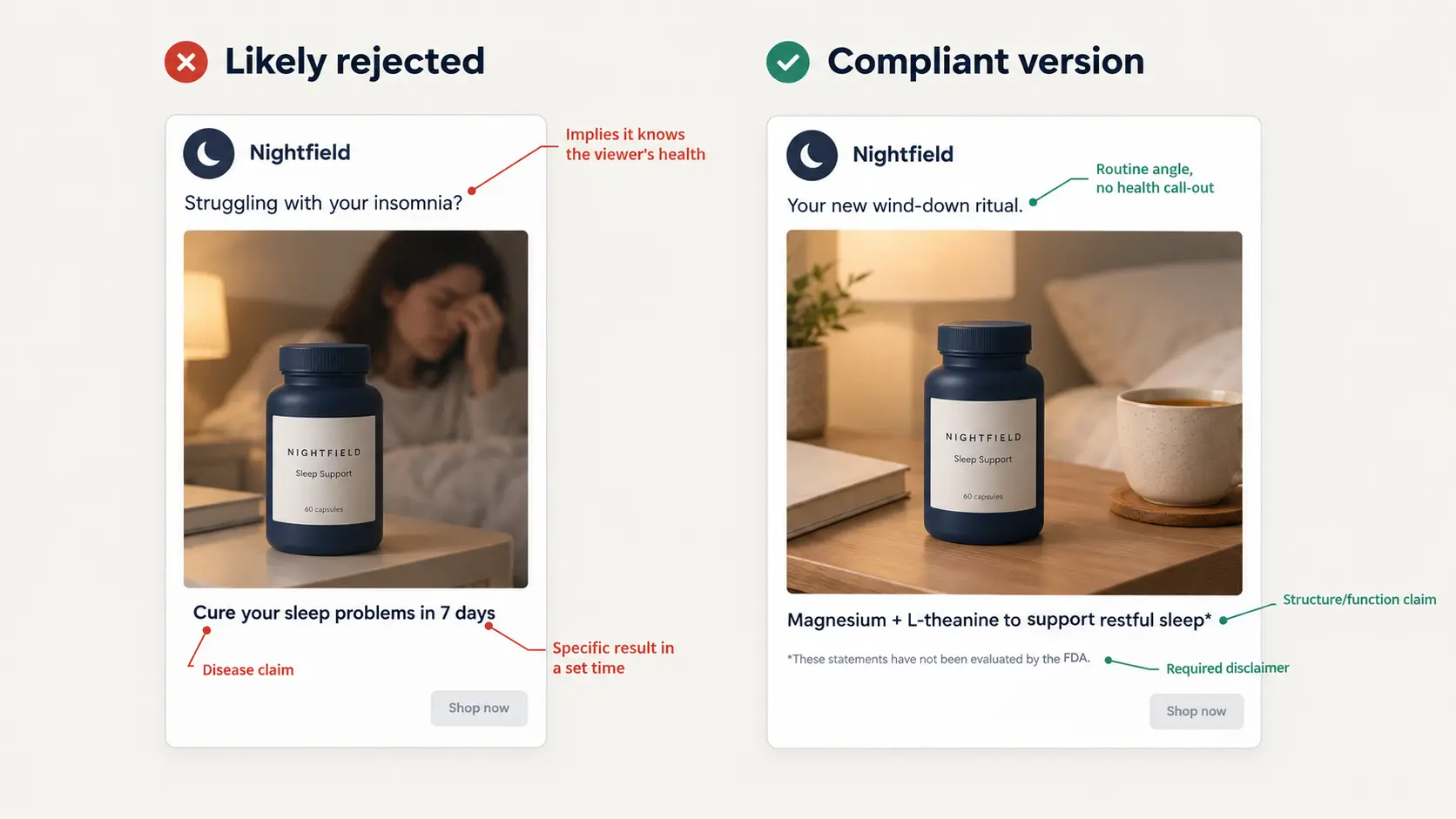
For a supplement brand, compliance has become mostly a creative problem.
What data Meta will let you use
The third layer only applies to some brands, but it's worth checking whether yours is one of them.
Since early 2025, Meta has restricted data sharing for advertisers it classifies as health and wellness.
Meta describes these as businesses associated with medical conditions or specific health statuses, and its examples include weight loss and diabetes supplements. (Meta Business Help Center)
If your account has been classified this way, you can lose the ability to optimize for purchase and add-to-cart events. The algorithm is working from weaker signals, which makes every winning ad worth even more.
Plenty of supplement brands aren't affected. But if your results dropped sharply in 2025 and you never found out why, look here.
What that does to your pipeline
Put the three layers together and the effect on creative is predictable.
The angles that would convert best are the ones you can't run as written. The territory that's left is narrower, so each angle in it gets used up faster.
And because a rejected ad, or a restricted account, is expensive, teams start playing it safe. The ads get more careful, and then more similar to each other. The ad account fills up with variations of the same two or three ideas.
None of this is imagined. Brands that ignore these rules lose ad accounts, and a supplement founder who says the rules are tight is right.
But look at what the rules limit. They limit what you can say, and so they shrink the supply of ads you can run. They don't set a cap on how much a supplement brand can spend on Meta.
The brand spending $200,000 a day works under exactly the same rules.
That's why adding more channels doesn't solve this. You'd be taking a narrow creative supply and splitting it across more places. The fix is more volume and wider angles inside the rules, and we'll get to how later in the post.
What every new channel really costs
Start with a smaller version of the same decision, inside a single Meta account.
Split one campaign into three, one per product, and each gets less budget and less data to learn from. Costs usually rise. That's worth it when the products really have different customers or margins. Otherwise you're paying for tidiness.
Every split has to earn its place.
Adding a channel is the same decision, one level up. You're splitting the budget, the creative team's output, the data each platform learns from and your own attention.
For the brand in this story, going from one main channel to six cost them in four ways.
More creative. Every channel wants its own formats and styles. A team already short of winning ads for one platform was now producing for six, and in supplements every new asset also goes through compliance review.
More people and process. Each channel brought its own media buyer or agency, with its own workflow and reporting. The founder's week filled up with calls and handoffs, time taken from the product and the offer.
More confusion about what's working. Channels overlap in what they claim. A customer who saw a Meta ad, heard a podcast mention and searched on Google gets counted by all three.
This is why the brand called us: they couldn't tell which channels were paying for themselves.
Less from each dollar. Meta is usually the channel a supplement brand has tested and tuned the most. A dollar moved into a newer channel picks up extra overhead, and it often buys fewer new customers than it did on Meta.
A second channel can still be the right call. It just has to cover those costs before it adds anything.
So for each channel you run today: what's your evidence that it brings in customers you wouldn't have got anyway? If the honest answer is "the platform's own report," you don't know yet. We'll come to how to find out near the end of the post.
Check the math before you blame the channel
Before testing whether Meta is maxed out, there's one more thing to rule out. It's the thing this brand missed first.
Every business has one main constraint holding it back at any given time. Most founders assume it's cash, or the channel. Quite often it's the unit economics: how much each customer is really worth, against what it costs to get them.
For this brand, that was the real constraint.
They were paying about $120 to acquire each customer, which is their CAC, or customer acquisition cost. Once the numbers were corrected, the most they could afford to pay was about $90.
Three things had pushed their estimate too high. Their inventory costs were understated, so every sale looked more profitable than it was.
Their estimate of lifetime value was too optimistic. And they were setting targets from their average CAC, when the customers at the edge of their spend were costing far more than the average.
(What's a good CAC for supplement companies walks through how those three mistakes stack, and how under-costed inventory shows up in your numbers covers the first one.)
This matters here because a brand spending past its real limit sees exactly what a saturated brand sees. Costs keep rising, revenue stays flat, and profit goes nowhere.
For this brand it was harder still to see, because strong retention kept total revenue looking stable. Returning customers were covering for the new ones who weren't paying back. (Why high retention can destroy supplement brands covers how that happens.)
Better creative can't fix that on its own. If each new customer costs more than they'll ever earn you, a winning ad just helps you acquire more of them.
More channels make it worse, because they add cost and bury the problem under more attribution noise.
So the order matters. Fix your ceiling first, then ask whether Meta is maxed.
For this brand, that meant pulling their CAC target down by 30 to 40% before anything else changed.
That hurt, because spending less to acquire customers means revenue goes down in the short run. It was also the only way the next steps could work.
Saturated, or just the most you've ever spent?
When we raised all of this with the brand, they pushed back, and it was a reasonable objection.
From where they sat, $200,000 a month on Meta was a lot of money. It was more than they'd ever spent. Costs had risen as they got there, so it felt like the top.
Abir's answer was that this was a limiting belief. They felt they'd saturated Meta because $200,000 a month was the level they were used to spending.
That's when he mentioned the other supplement brand. Similar niche, and by his own description a less impressive-looking brand, spending about $200,000 a day.
A comparison like that is useful because it rules out the easy explanation. It doesn't prove your brand can spend that much. So here's how to test it on your own numbers.
Test 1: Look at spend in blocks, not on average
Your monthly cost per customer is an average. The customers you win first are cheap, and the ones you win last, as you push spend up, cost the most.
Here's an illustrative month for a brand spending $150,000 on Meta, where each customer is worth up to $124 in lifetime gross profit. Split the spend into three blocks and look at what each one bought.
Illustrative figures. Lifetime contribution is lifetime gross profit minus acquisition cost.
The average looks healthy: $65.30, well under the $124 limit. The third block is losing money on every customer it buys.
That third block is where "we've saturated Meta" usually starts. It's also where a new winning ad makes the biggest difference, because it's the most expensive money in the account.
So when you judge whether Meta is maxed, judge it on your last block of spend, not your average.
Test 2: Check what happened the last time spend went up
Your own history is the best evidence you have. Here's what it looked like for this brand, by year:
- Year 1: CAC of $40.
- Year 2: they nearly doubled ad spend, and CAC only rose to $45.
- Year 3: they doubled spend again, and CAC rose to $70. A big jump, but worth it for the extra volume.
- Year 4: they cut ad spend, and CAC still rose, to about $120.
The first two years show a brand with plenty of room on Meta. Spend doubled and costs barely moved.
Year 4 is the telling one. If the audience had simply been used up, cutting spend should have eased costs. They rose anyway.
When costs rise while spend is falling, look inside the machine before blaming the platform. For this brand, part of it was the offers.
They'd been testing new ones to win customers, and the share of new customers taking a subscription had dropped from about half to about a quarter.
Now ask the same of your own account. When your spend last went up, did your cost per customer move a little or a lot? And the last time you found a winning ad, did your most expensive block of spend come down?
If it did, the platform isn't your ceiling. If new winners have stopped moving it at all, you may be closer to a real limit.
Test 3: Don't treat rising CPMs as the verdict
Rising CPMs, the cost of reaching a thousand people, are the most common "proof" of saturation. On their own they tell you very little.
Tighter targeting pushes CPMs up. Broad, meme-style creative can pull them down. So a higher CPM can simply mean your ads are reaching a more specific audience.
The numbers that decide it sit further down the chain: click-through rate, cost per click, conversion rate, average order value, and the contribution margin you're left with at the end.
If those are holding up, a higher CPM isn't the problem.
Test 4: See how much of your spend rides on a few old ads
Open your ad account and sort by spend over the last 30 days.
If one or two ads are carrying most of the budget, and they've been running for months, what you're seeing is fatigue on a thin bench of creative. That's the version of the problem new ads can fix.
If all four tests point at creative, the ceiling is yours to raise.
Building the creative machine that raises the ceiling
At this brand's level of spend, the bottleneck is almost always creative.
How much you can spend on Meta before costs climb depends on how many ads you have that can win. To spend more, you need a steady supply of new winners, which means building a way to keep producing them.
That's what "earn the right to spend more" means in practice. The ceiling moves when your creative supply does.
Put about 10% of ad spend into new creative
A useful rule of thumb is to spend roughly 10% of your ad budget on making new creative.
At $200,000 a month, that's about $20,000 a month going into new ads, every month, whether or not the current ones are still working.
So here's a quick check. What did you spend on new creative last month, as a share of what you spent on ads? (How to build a marketing budget covers where that line sits in the wider budget.)
Track your hit rate
Volume on its own isn't the goal. Once new ads are going out regularly, track how many of them become winners.
That number tells you which problem you have.
If about one ad in a hundred wins, the problem is strategy. You're most likely testing variations of angles that don't work, and making more of them won't help. Go back to what you're saying.
If you're finding winners often, the problem is that you're not spending enough. Put more behind the creative, and more behind the winners.
Either answer is useful. Not knowing your hit rate is the only bad one.
Start from the result your customer wants
Supplements can't promise outcomes the way other products can. You can still build angles around the outcome, as long as the claims stay inside the rules.
Start with the best possible version of your customer's life with the product in it. The mornings they want to have, how they want to feel at 3pm, the routine they want to stick to.
What people are really buying is energy, focus, better sleep, or a body they feel good in. The product is part of how they get there.
Then work backwards to angles you're allowed to run. For example:
- The routine: what a normal morning looks like with the product in it
- The ingredient: what's in it, where it comes from, and why that one
- The founder: why the product exists and who it was made for
- The format: taste, texture, how easy it is to take
- The proof: reviews and social proof that stay inside the claims rules
Each of those is a separate angle, a different reason to buy. That's how you widen the territory you're working in, instead of recutting the same ad.
Lead with your most advertisable product
You don't have to advertise the whole catalog.
Most supplement ranges have one product that works best on cold traffic. In this category, it's also worth asking which product gives you the most room to talk.
A product with more claims you can actually make gives your creative team more angles to work with.
Make that product the entry point for new customers. Let the rest of the range do its work in bigger orders, retention and follow-up offers after the first purchase.
Build compliance into the process
In a supplement brand, compliance review is part of how fast you can produce creative. Treat it that way.
Review scripts and concepts before production, not after an ad gets rejected. Keep a running list of claims and phrases that have already been approved, so the team writes inside the lines from the start.
That way, the rules shape the ideas early instead of killing finished ads late.
What this brand did
For the brand in this story, this was the second half of the fix.
Once their CAC target was reset, they wound down the extra channels and moved that budget back into Meta. Then they brought in creative agencies, specifically to raise the volume of ads they could feed into it.
When a supplement brand should add a channel
Everything so far argues for putting more into Meta. That doesn't make every other channel a mistake.
There are good reasons to add one. Each still has to earn its place against the costs from earlier in this post, but these are the ones that usually can.
To protect against losing your ad account
Supplement ad accounts do get restricted. If Meta is your only working channel, one bad week of enforcement can stop acquisition entirely.
A second channel that already works is insurance against that, and that's a legitimate reason to run one on its own.
Just be clear about what you're buying, and size it like insurance. It needs to be big enough to keep new customers coming in if Meta goes dark. It doesn't need to match Meta's returns.
Because you're already on Amazon
Most supplement brands already sell on Amazon, and your Meta ads are already sending people there. Plenty of customers see an ad, then search your brand on Amazon and buy it there out of habit.
That's a channel you already have, and the work is in measuring it properly. Amazon vs Shopify for supplement brands covers how to count what your ads are earning on Amazon without fooling yourself.
Because Meta really is near its peak for you
At some point, the tests in this post will start pointing the other way.
Your creative machine is running. You're putting real money into new ads, your hit rate is healthy, and you're finding winners. But your last block of spend still won't come in under what a customer is worth to you.
That's the point where the next dollar may do more somewhere else. Most brands that think they're there aren't yet. Some are.
Because a test shows it's bringing in new customers
Any channel you add should prove it's winning customers you wouldn't have got anyway, and not just taking credit for customers Meta already found.
The cleanest way to find out is a holdout test.
Turn the channel off in some regions, keep it running in others, and compare what happens to new customers in each. (How incrementality testing works walks through setting one up.)
One channel at a time
Whatever the reason, add channels one at a time. Give each one its own limit on what it can pay for a customer, and a way to prove it's adding customers.
The brand in this story spread into six channels in response to a flat dashboard, with no way to tell which were working. That's the version to avoid.
Putting it together
If your Meta results have stopped growing, work through it in this order:
- Check your CAC ceiling first. Spending past what a customer is worth looks exactly like saturation from the outside.
- Test for saturation on your last block of spend, not your average, and see whether new winners still bring it down.
- Put about 10% of ad spend into new creative, and track how often it produces a winner.
- Widen your angles inside the rules, and lead with the product that gives you the most to say.
- Add channels one at a time, and make each one prove it's bringing in new customers.
The brand in this story did it in roughly that order. They reset their CAC target, wound down the extra channels, moved the budget back into Meta, and brought in creative agencies to feed it.
They were never short of platform. The brand spending $200,000 a day works under exactly the same rules they do.
If you'd rather see this on your own numbers
The tests above are doable yourself, and if you run them and they come back clean, that's a real answer.
The hard part is usually knowing which problem you have. Rising costs and flat revenue look the same whether the cause is the platform, your creative, or the math underneath your targets.
That's what the Growth Cash Dash is for. We take your historical numbers, run them through 30+ ecommerce finance KPIs, and come back with the ones that are telling a story your dashboard isn't.
Sometimes it shows Meta has plenty of room and the creative needs to catch up. Sometimes it finds a $90 ceiling sitting underneath a $120 CAC.
Either way, you'll know which one you're dealing with before you add another channel.





.jpg)